-
Free Delivery
-
Buy Direct from the Makers
-
Aftersales Support
Wet/Dry Vacuum Filtration Systems Explained: HEPA vs. Standard Filtration
Share
Is a HEPA filter better than a standard filter on a wet and dry vacuum? Yes — but it depends on what you're cleaning. A HEPA filter captures much finer airborne particles than a standard cartridge filter, making it the better choice when vacuuming fine household dust, allergens or workshop debris that can become airborne. A standard wet and dry vacuum filter is suitable for everyday jobs such as sawdust, wood chips, garden debris and general household cleaning, particularly when airflow and ease of maintenance are the priority.
It's also important to remember that not every wet and dry vacuum uses a HEPA filter by default, and not every cleaning task requires one. Choosing the right filtration system depends on the material being collected, whether you're vacuuming wet or dry debris, and the manufacturer's recommended accessories.
Understanding Wet and Dry Vacuum Filtration
A wet and dry vacuum cleaner is designed to collect both liquids and solid debris using interchangeable filters and accessories. Unlike a conventional household vacuum, these vacuums are built to handle larger particles, heavier workloads and occasional spills.
If you're new to this type of appliance, our guide "What Is the Difference Between a Wet and Dry Vacuum Cleaner and a Regular Vacuum?" explains the key differences between the two cleaning systems.
Most wet and dry vacuums use one of two filtration approaches:
- Standard cartridge or reusable filters
- HEPA filters (available on selected models or as compatible accessories)
Both have their place, but they solve different problems.
What Is a Standard Wet and Dry Vacuum Filter?
A standard filter is designed for general cleaning where the main objective is collecting visible debris efficiently. Typical jobs include:
- Household dust
- Wood shavings
- DIY renovation debris
- Garden waste
- Garage floors
- Car interiors
- Liquid pick-up (using the correct wet configuration)
Standard filters are commonly used for general cleaning tasks and can be straightforward to maintain and reuse, depending on the filter type. Finer filtration can create greater airflow resistance, but the actual suction performance of a wet and dry vacuum depends on its overall design, including the motor, airflow system and filter.
For most homeowners, this is the filtration system used for everyday maintenance.
What Is a HEPA Filter?
HEPA stands for High Efficiency Particulate Air.
Under the European standard EN 1822, HEPA filters are classified according to their efficiency, with grades including H13 and H14. A H13 filter is tested to capture at least 99.95% of the most penetrating particle size (MPPS) under laboratory conditions, while H14 captures at least 99.995%.¹
Because of this high filtration efficiency, HEPA filters are commonly used in environments where controlling fine airborne dust is important. Examples include:
- Fine sanding dust
- Drywall dust
- Fine plaster particles
- Some workshop applications
- Household cleaning where reducing airborne fine particles is desirable
For regulated or hazardous workplace dust, filter efficiency alone is not enough to determine whether a vacuum is suitable. Users should choose equipment that is appropriately certified and designed for the specific type of dust being collected.
This is also why a wet and dry vacuum and a dedicated dust extractor should not be treated as interchangeable products. The appropriate equipment depends on the material being collected, working environment and applicable requirements.
HEPA vs Standard Filtration: Side-by-Side Comparison
| Feature | Standard Filter | HEPA Filter |
|---|---|---|
| Everyday household cleaning | ✔ Excellent | ✔ Excellent |
| Fine dust control | Good | Better |
| Airflow | Higher | Slightly more restrictive |
| Maintenance | Easy | Requires more frequent cleaning or replacement |
| Wet vacuuming | Depends on machine configuration | Depends on machine configuration |
| DIY renovation | Suitable for most jobs | Better for very fine dust |
| Cost | Lower | Usually higher |
The best choice depends on your cleaning routine rather than assuming one filter is universally superior.
Which Filter Should You Choose?
Choose a standard filter if you regularly clean:
- Garages
- Cars
- Workshops
- Patios
- Garden sheds
- General household mess
For these jobs, durability, airflow and quick maintenance are often more important than capturing the smallest airborne particles.
Consider HEPA filtration if you frequently vacuum:
- Fine sanding dust
- Drywall residue
- Renovation dust
- Fine workshop debris
Always check whether the manufacturer recommends a HEPA filter for your specific vacuum model.
Does the Vacuum Matter as Much as the Filter?
Yes. Filter type is only one part of the buying decision. A vacuum's motor, airflow system, filter design, seals, hose configuration and collection capacity can all influence how it performs in real-world cleaning.
More importantly, the right vacuum depends on what you need to clean. If your primary requirement is general-purpose wet and dry cleaning rather than hazardous fine-dust extraction, a high-capacity wet and dry vacuum may be a more appropriate choice than selecting a machine based on HEPA filtration alone.
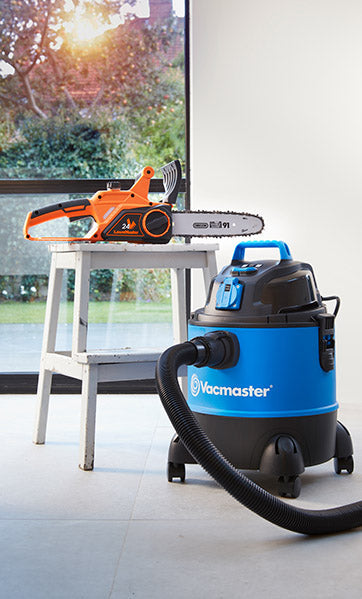
For homeowners tackling regular DIY projects, garage cleaning and outdoor mess, the Vacmaster Power 30 PTO Wet & Dry Vacuum Cleaner is designed for larger cleaning tasks around the home, garage and workshop. It combines:
- 30-litre stainless steel collection tank
- Wet and dry cleaning capability
- Power Take Off (PTO) socket for compatible power tools
- Blower function for clearing leaves and loose debris
The Power 30 PTO uses a standard filtration configuration rather than HEPA filtration.

Can You Use a HEPA Filter for Wet Vacuuming?
Not necessarily. Most wet and dry vacuums require different filter configurations depending on whether you're collecting liquids or dry debris. Before vacuuming liquids:
- Follow the manufacturer's instructions.
- Remove or replace filters where recommended.
- Empty the tank promptly after wet collection.
- Allow reusable filters to dry fully before storing them, if applicable.
Using the wrong filter configuration may reduce performance or shorten filter life. Always refer to the user manual for your specific model.
Maintaining Filtration Performance
Whichever filtration system you choose, routine maintenance helps maintain cleaning performance. Good practice includes:
- Empty the collection tank before it becomes overfilled.
- Clean reusable filters according to the manufacturer's instructions.
- Replace damaged filters promptly.
- Allow wet components to dry completely before storage.
- Store the vacuum in a dry location.
A clean filter generally provides better airflow than a clogged high-efficiency filter.
Common Misunderstandings About HEPA Filters
“HEPA means the vacuum removes every harmful particle.”
No. A HEPA-rated filter is tested under defined laboratory conditions for particle capture efficiency, but this does not automatically mean that the entire vacuum cleaner is HEPA-certified. Overall filtration performance also depends on the complete machine, including filter sealing, airflow design and correct maintenance.
“HEPA is always necessary.”
Not for every user. If your cleaning mainly involves leaves, soil, wood chips or household debris, a standard filter is often entirely appropriate.
“Every wet and dry vacuum includes HEPA.”
No. Some models offer HEPA filters as optional accessories, while others are supplied with standard cartridge filters. Always check the product specification before purchasing.
Choosing the Right Wet and Dry Vacuum
When comparing machines, consider more than just filtration. Ask yourself:
- Will you clean mainly wet spills or dry debris?
- How much fine dust do you expect?
- Do you need a larger tank for longer cleaning sessions?
- Will you connect power tools?
- Do you need blower functionality?
Answering these questions usually leads to a better buying decision than focusing on filter type alone.
Final Thoughts
When comparing wet dry vacuum HEPA filter vs standard, there is no universal winner.
A standard filter is the cost-effective and practical choice for many everyday cleaning jobs, offering strong airflow and straightforward maintenance. A HEPA filter becomes more valuable when your work regularly generates fine airborne dust that benefits from higher filtration efficiency.
The most effective solution is to match the filtration system, vacuum capacity and accessories to the cleaning task rather than assuming one filter suits every situation.
If you're looking for a versatile machine capable of tackling household cleaning, garages, workshops and DIY projects, the Vacmaster Power 30 PTO Wet & Dry Vacuum Cleaner is a practical option. For a wider range of models, browse the Vacmaster Wet & Dry Vacuum Cleaner collection to compare capacities and features that best match your cleaning needs.